
The transition from undergraduate studies to a Master of Business Administration (MBA) program is more than just a step up the academic ladder. It is a fundamental shift in environment, mindset, and culture. In college, your primary goal is to show the professor that you read the textbook, memorized the theories, and can academicize your thoughts into a structured format. In an elite business school setting, however, that style of writing falls completely flat.
Admissions boards and business professors are not looking for academic summaries. They are looking for clear indicators of executive leadership, strategic foresight, and a solid understanding of business return on investment (ROI). While utilizing a professional assignment and essay writing service can help students master foundational prose and manage heavy course loads during their undergraduate years, transitioning to a specialized post-graduate application requires a fundamental shift in tone. To stand out and climb into the top tier of candidates, you must completely overhaul how you communicate on paper.
1. The Core Mindset Shift: From Academic Informer to Business Leader
The most glaring difference between undergraduate and MBA-level writing lies in the ultimate objective of the piece. Undergraduate writing is largely descriptive. You are given a prompt, you research what experts have said, and you compile those perspectives into an analytical paper. You are acting as an informer, proving your academic competence to a grading rubric.
MBA writing is inherently action-oriented and persuasive. You are no longer writing for a professor; you are writing for a hypothetical board of directors, an investment committee, or an admissions board that reviews thousands of highly competitive profiles. They do not need you to define a marketing theory or summarize a financial concept. They want to know how you would apply that theory to solve a multi-million-dollar logistical bottleneck, mitigate organizational risk, or scale a global startup. Every sentence must move away from “what happened” and focus entirely on “what this means for the business and how we execute the strategy.”
2. Structural Differences: Navigating the Two Writing Environments
To successfully pivot your writing style, it helps to look at how these two environments approach structural organization. College essays often follow the traditional five-paragraph model, relying on long, narrative introductions and slow, winding conclusions. Business writing flips this structure upside down to accommodate busy, decision-making professionals.
| Writing Attribute | Undergraduate Level | MBA & Executive Level |
| Primary Goal | To demonstrate knowledge and display academic research. | To drive strategic decisions and demonstrate leadership potential. |
| Organizational Structure | Linear, narrative-driven (Introduction $\rightarrow$ Body $\rightarrow$ Conclusion). | Front-loaded (Executive Summary $\rightarrow$ Data $\rightarrow$ Actionable Recommendations). |
| Tone & Voice | Formal, passive, third-person, and highly theoretical. | Direct, active, first-person, and intensely outcome-oriented. |
| Data Presentation | Integrated into long paragraphs as textual citations. | Quantified, isolated, and presented through clear, strategic metrics. |
3. Stripping the Academic Fluff: Embracing Executive Brevity
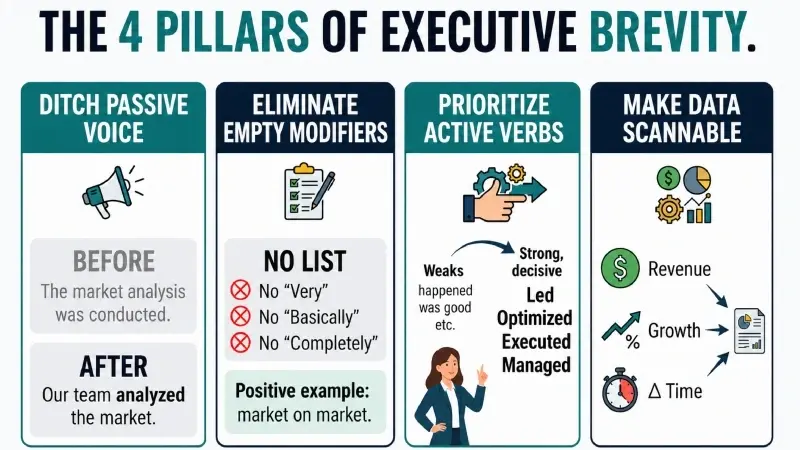
In undergraduate courses, students frequently fall into the trap of using overly complex language, passive sentence structures, and filler words to meet strict page or word counts. In the corporate and business school ecosystem, excessive wordiness is viewed as a lack of clarity and a major red flag.
Executive brevity does not mean stripping your writing of intellectual depth. It means conveying complex, multi-layered strategic ideas in the fewest, most impactful words possible.
- Avoid the Passive Voice: Instead of writing “The market analysis was conducted by our team, and it was discovered that sales were declining,” use the active voice: “Our team analyzed the market and identified a distinct decline in sales.” The active voice assigns accountability, shows ownership of actions, and creates a fast-paced, authoritative narrative rhythm.
- Cut Empty Modifiers: Words like very, completely, totally, and basically add zero value to a professional business text. Instead of saying a budget deficit is “very problematic,” quantify the impact: “The budget deficit threatens operational liquidity for Q3.”
- Write Scannable Prose: MBA professors and corporate leaders scan documents before they read them in detail. Use short, punchy paragraphs, precise bullet points for complex data sets, and highly descriptive headers that signal exactly what value the upcoming section delivers.
4. The Art of Personal Positioning in Admissions Narratives
The hardest part of this transition for most undergraduate seniors is learning how to write about themselves. College papers train you to remain invisible, hidden behind third-person objective phrases like “this paper will analyze” or “one could argue.”
When you sit down to draft your business school applications, this invisibility will hurt your chances. Admissions committees are not buying an essay; they are investing in your future leadership trajectory. They need to see your specific choices, your unique contributions, and your distinct resilience under pressure. This requires a masterful execution of professional first-person storytelling.
Navigating these highly specific prompt structures often requires a dedicated MBA admission essay writing service to ensure the applicant’s professional trajectory aligns with institutional expectations. By leveraging the expertise of an established global platform like Myassignmenthelp, applicants can learn how to balance personal humility with clear, data-backed professional authority. Expert consultants help you look back at your early career or undergraduate achievements and translate them into stories of true organizational impact, ensuring your application speaks the exact language that elite business schools want to hear.
5. The “STAR-E” Framework for Business Impact
When you are asked to write about a professional challenge, a leadership experience, or a business case study, do not just tell a story chronologically. Use a structured, executive framework to keep your writing focused on high-level results.
A highly effective tool for this is the STAR-E Method, which expands on traditional communication frameworks to meet elite business school standards:
- Situation: Set the scene quickly. What was the exact baseline, market condition, or problem your organization was facing? Keep this part brief.
- Task: Define the clear challenge. What was your specific responsibility within this scenario, and what were the key metrics you needed to improve?
- Action: Explain your strategic execution. What steps did you take? Focus heavily on your personal decision-making process, your allocation of resources, and how you led others.
- Result: Quantify the outcome. Never just say things “improved.” Use concrete data: “Increased operational efficiency by 14%,” or “Saved $20,000 in unnecessary quarterly overhead.”
- Executive Impact: Tie the result back to the big picture. How did this action position the organization for long-term growth, and what did it prove about your foundational leadership philosophy?
Frequently Asked Questions (FAQ)
Q.1 What is the biggest difference between college writing and business school writing?
Undergraduate writing focuses on demonstrating academic knowledge and summarizing existing theories in a passive, theoretical tone. MBA writing focuses on strategic decision-making, direct leadership communication, and presenting data-backed solutions to real-world business challenges.
Q.2 Can I use the first-person perspective (“I” or “We”) in an MBA essay?
Yes. While undergraduate courses often discourage using “I,” MBA admission essays and professional business case studies require it. The admissions committee wants to see your personal decision-making, your leadership actions, and your individual contributions to a project.
Q.3 How do I make my business writing sound more professional and less academic?
Focus on executive brevity. Use active verbs, cut out filler words, keep your paragraphs short, and lead with your main conclusion or recommendation before diving into the supporting data.
Q.4 Why is quantifying results so important in postgraduate business papers?
In business, impact is measured through data, revenue, efficiency gains, and ROI. Saying an initiative was “highly successful” is vague and unconvincing. Stating that the initiative “reduced project delivery times by 22% over a six-month period” provides undeniable proof of strategic success.
About The Author
My name is John Martin, and I am a senior academic consultant and higher education strategist at MyAssignmentHelp. With over a decade of experience helping undergraduate students transition into elite postgraduate and management programs, I specialize in decoding admissions criteria and stripping the academic fluff from professional prose.